
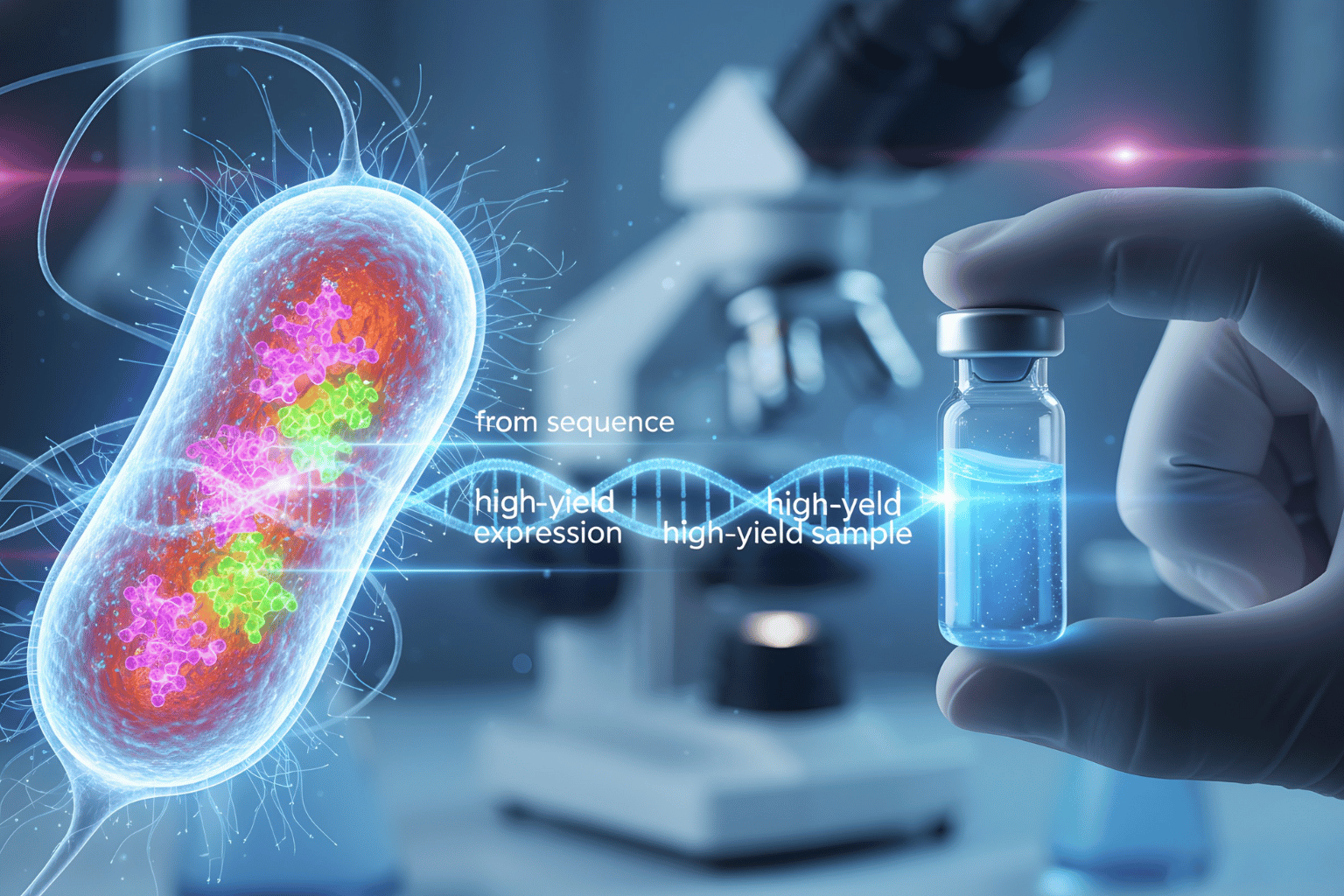
In research, every second and every microgram of protein counts. Grant deadlines loom, publications are pending, and you need a reliable, cost-effective, and scalable method to produce your protein of interest.
While newer, more complex expression systems get a lot of attention, one host remains the undisputed workhorse of molecular biology: Escherichia coli.
For Principal Investigators, CSOs, and research scientists, E. coli is often the first—and best—choice for recombinant protein production. But navigating the path from a gene sequence on your computer to a functional, highly purified sample in a tube requires a strategic approach.
This guide will walk you through the why, the how, and the when of E. coli expression, ensuring your next run is set up for success from day one.
Why E. coli Remains the PI’s Workhorse for Protein Expression
First used for recombinant protein in the 1970s, E. coli is not just a legacy system; it’s a highly optimized and robust platform. For a research lab or a startup CSO, the advantages are clear and compelling.
- Rapid Growth & High Yields: With a doubling time of as little as 20 minutes, you can go from culture inoculation to a high-density cell slurry in a single day. This rapid biomass accumulation translates directly into high yields of recombinant protein, often reaching grams per liter of fermentation media.
- Cost-Effectiveness: Compared to the expensive, complex, and serum-dependent media required for mammalian cell culture, E. coli thrives on simple, inexpensive media. This makes it ideal for budget-conscious labs and for projects that require more than just a few milligrams of protein.
- Well-Defined Genetics: Decades of research mean we understand the E. coli genome and its expression pathways better than any other organism. An extensive library of expression vectors, promoter systems (like T7), and engineered host strains gives you exquisite control over your protein’s expression.
- Proven Scalability: The process you optimize in a 250 mL shake flask can be directly scaled up to a 5 L, 50 L, or 500 L fermenter, providing a clear, low-risk path from benchtop research to production-level quantities.

Is Your Protein a Good Candidate for E. coli Expression?
This is the most critical question to ask before you start. E. coli‘s primary limitation is its lack of complex post-translational modifications (like glycosylation) found in eukaryotes.
However, for a vast majority of research and industrial enzymes, E. coli is the perfect host, especially if your target protein has these characteristics:
- Size and Simplicity: It excels with smaller proteins (typically < 100 kDa) that have simple, single-domain folds.
- High Solubility: The protein is known to be water-soluble and does not require complex chaperone folding.
- Stable Conformation: The protein is inherently stable and less prone to misfolding into insoluble inclusion bodies. It should not contain long disordered sequences.
- No PTMs Required: The protein’s function does not depend on eukaryotic modifications like glycosylation or complex disulfide bonding.
If your protein ticks these boxes, E. coli offers the fastest and most reliable path to a high-yield sample.
Planning your next expression run? Getting the setup right is critical.
Download our free E. Coli Expression Optimization Checklist to ensure your protein, vector, and host are aligned for success.
Choosing Your Scale: Shake Flasks vs. Fermenters
Once you have your plasmid, your expression strategy will depend on your goal. Your equipment choice dictates your final yield.
1. The Shake Flask: Your Go-To for Initial Screening
This is the classic method for a reason. Using a heated, refrigerated incubator, shake flasks are perfect for:
- Testing different host strains.
- Optimizing induction parameters (e.g., IPTG concentration, temperature).
- Screening multiple constructs or mutants simultaneously.
The limitation is oxygen. As cells grow, oxygen becomes depleted, growth slows, and yields plateau. This is perfect for initial validation but not for producing large amounts of protein.
2. The Fermenter: Your Solution for High-Yield, High-Density Culture
When you need quantity and reproducibility, you need a fermenter vessel (bioreactor). A fermenter provides active, real-time control over:
- Dissolved Oxygen (DO): Sparges air or O2 to keep cells in a perfect aerobic state.
- pH: Actively adds acid/base to prevent toxic metabolite buildup.
- Feeding: Uses a “fed-batch” strategy to slowly feed the culture, allowing it to reach incredibly high cell densities (OD600 of 50, 100, or more) before induction.
This high-density culture is the key to maximizing your final yield, turning a milligrams-per-liter process into a gram-per-liter one.
From Sequence to Sample: Your E. coli Expression Partner
A successful protocol is more than just equipment; it’s about the expertise to design and execute a robust process. A PI or CSO’s time is better spent analyzing data and planning the next experiment, not troubleshooting a failed protein prep.
At Solidzymes, we act as an expert extension of your lab. We take the guesswork out of E. coli expression by managing the entire workflow for you.
- Comprehensive Plasmid Design: Our service starts where your project does—at the sequence. We can design and synthesize an expression-optimized plasmid, including codon optimization, tag selection (His, GST, etc.), and protease cleavage sites, to give your protein the best possible chance of success.
- Seamless Scaling (Flasks or Fermenters): Whether you need 10 mg of protein for initial screening or several grams for structural studies, we have you covered. We can perform initial optimizations in shake flasks then move directly to high-density culture in our 5 L fermenter to deliver the quantity and purity your project demands.
Ready to Start Your Next Project?
Stop spending valuable time troubleshooting inclusion bodies or low yields. Let the experts at Solidzymes deliver a high-purity, functional protein, so you can focus on the next breakthrough.
Contact Solidzymes today for a free consultation on your protein expression project.
References
- Rosano, G. L., & Ceccarelli, E. A. (2014). Recombinant protein expression in Escherichia coli: advances and challenges. Frontiers in Microbiology, 5, 172. https://doi.org/10.3389/fmicb.2014.00172
- Shiloach, J., & Fass, R. (2005). Growing E. coli to high cell density—A review. Biotechnology Advances, 23(5), 345-357. https://doi.org/10.1016/j.biotechadv.2005.04.004