
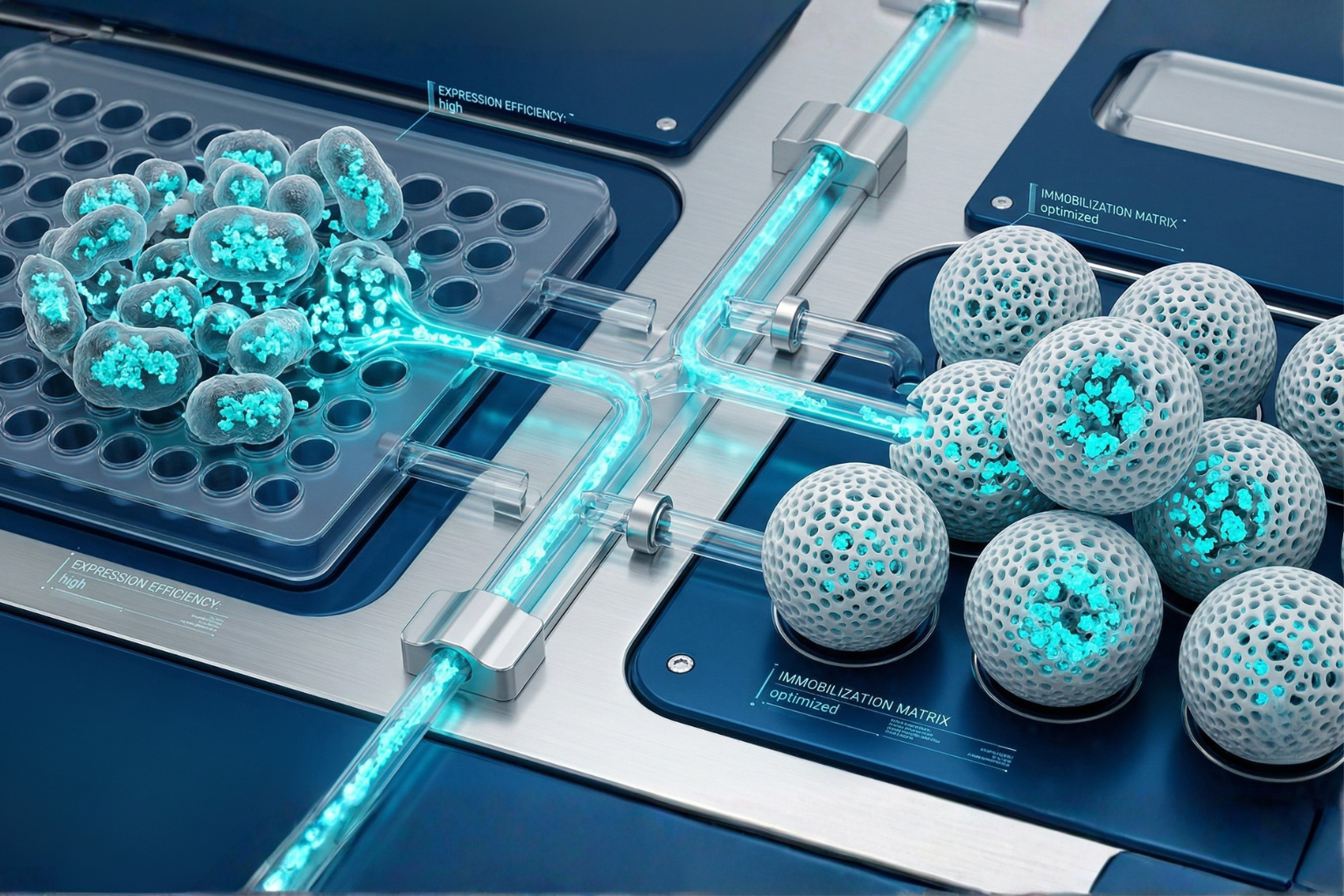
For biotech startups and established industrial facilities alike, scaling immobilized biocatalysts from a benchtop curiosity to a commercially viable process is a massive undertaking. Cell-free biocatalysis relies on enzymes isolated from living organisms – typically microbes – to drive complex chemical transformations under mild conditions. The ultimate success of a biocatalytic reactor hinges on the price and quality the materials used as well as the simplicity of the production process.
One way to ensure a high quality biocatalyst is to develop enzyme production and immobilization in tandem. This way the simplest, most cost effective, path to biocatalyst production can be found.
Struggling to scale your enzyme production efficiently? Schedule a call with a Solidzymes expert today to discuss your pipeline.
The Hidden Economics of Enzyme Production

When we talk to researchers in the field of biocatalysis, a common trap we see is treating enzyme production and enzyme immobilization as two isolated phases of R&D. In reality, how you produce your protein effects how you should immobilize it.
1. Maximizing Expression Levels to Cut Downstream Costs
High expression levels are critical because they allow you to achieve high enzyme yields while using the bare minimum of costly fermentation materials. Furthermore, high expression is beneficial because it increases the initial purity of your crude enzyme. When the target protein dominates the cellular lysate, competition between your enzyme of interest and extraneous biomolecules is minimized during the immobilization. This often means high expressing proteins can be immobilized successfully with less preparatory purification.
2. The Power of Protein Secretion
Dealing with intracellular enzyme expression means dealing with cell lysis – a notoriously difficult step to scale that also introduces host cell proteins, nucleic acids, and cell debris into your enzyme solution. Expressing your enzyme in a host that secretes it into the media can greatly simplify the isolation process. This way you effectively eliminate the need for large scale mechanical cell lysis and also separate your enzyme from host cell proteins and DNA that compete for space on enzyme carrier surfaces.
Ready to bypass the bottlenecks in your protein expression? Request a free quote from our contract research team.
Designing Immobilized Biocatalysts from Day One
When engineering immobilized biocatalysts, the best practice is to develop your enzyme production methods alongside your enzyme immobilization methods. Making strategic decisions early with your complete immobilized biocatalyst production process taken into consideration pays off in the long term.
- Recombinant Tags: The choice of recombinant tag directly affects both the production and immobilization phases. For example, adding a histidine tag to your enzyme amino acid sequence may reduce your expression yields. However, it allows you to use metal affinity interactions to immobilize your enzyme. This can allow very specific immobilization of your protein out of a complex cell lysate. If your enzyme prefers this immobilization method, then the gains in immobilized enzyme activity should be quantitatively compared to the losses in enzyme expression due to the histidine tag.
- Buffer Compatibility: The buffer matrix your enzyme ends up in post – purification can make or break your immobilization. If you are planning an anion exchange-based immobilization, it is important to produce and purify the protein in a low-salt solution. High salt concentrations will prevent the enzyme from interacting with binding sites on the support, preventing successful immobilization.
- Avoiding Reactive Reagents: If you are utilizing covalent immobilization, you must avoid producing or storing the enzyme in a solution that will react with the support surface. A classic mistake is purifying an enzyme into a Tris buffer when you intend to use an aldehyde-coated support. The primary amines in Tris will react with the aldehydes, effectively “capping” the support before your enzyme can attach.
- Formulation and Storage: Finally, proteins are often lyophilized (freeze-dried) or spray-dried for long-term storage before they are used for immobilization. These intense drying processes often result in loss of enzyme activity, so when possible it is preferable to carry out immobilization immediately after protein production. When drying is necessary, it is important to screen drying conditions that will preserve enzyme activity (ie. lyoprotectants, salts), and also remain compatible with enzyme immobilization. A common mistake is to freeze dry a large volume of enzyme then rehydrate in a small volume resulting in too high salt concentrations for the desired enzyme immobilization.
The Solidzymes Solution: An Integrated Pipeline
At Solidzymes, we have the experience to help you with both enzyme production and immobilization. We offer integrated services for both, ensuring that the buffer, tag, and purity profiles of your upstream process make sense with the chemistry of your downstream solid support. By developing these methods in tandem, we help you find the right approach to producing robust, scalable, immobilized biocatalysts.
Book a strategy call with our experts today.
References & Further Reading
For teams looking to dive deeper into the optimization of expression, purification, and immobilization, we recommend the following references:
- “A Comprehensive Guide to Enzyme Immobilization: All You Need to Know” (2025). Molecules. (An excellent overview of how upstream purity dictates the success of various immobilization chemistries).
- “Secretion of recombinant proteins from E. coli“ (2018). Engineering in Life Sciences. (A review covering approaches to optimizing recombinant protein secretion efficiency).
- “Effectiveness of Lyoprotectants in Protein Stabilization During Lyophilization” (2024). Pharmaceutics. (A critical look at the formulation chemistry required to protect enzyme tertiary structure during freeze-drying and long-term storage).