
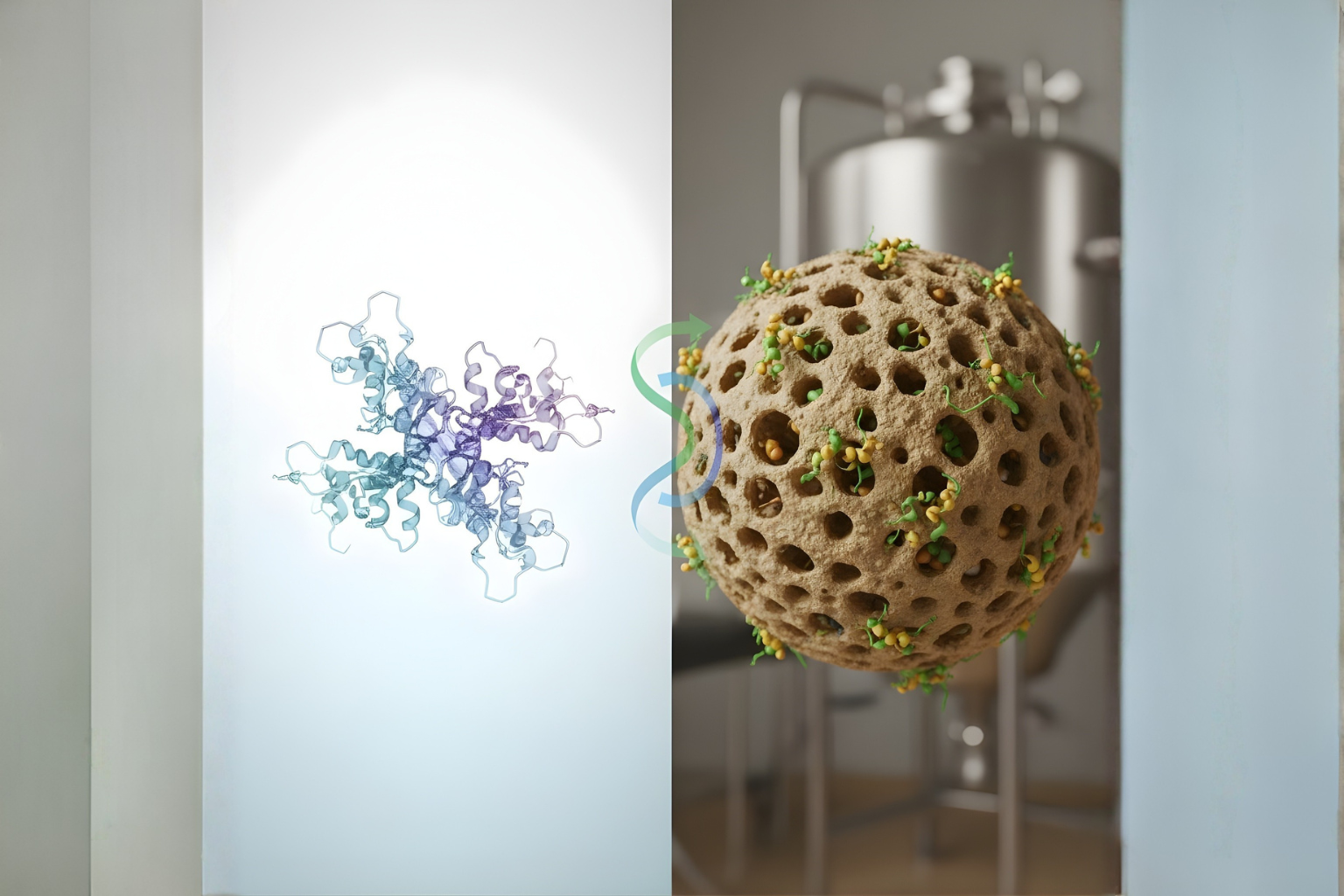
You’ve done it. After countless hours in the lab, you’ve engineered the perfect enzyme. It has the potential to revolutionize a manufacturing process or unlock a new frontier in your research. But now comes the critical next step: your immobilization strategy.
Attaching your protein to a solid surface is essential, but it’s not a one-size-fits-all solution. The strategy that works flawlessly for purifying a small batch for analysis could spell disaster when trying to build a robust industrial bioreactor. Choosing the wrong path can lead to lost activity, wasted resources, and stalled projects.
So, how do you choose? The answer depends entirely on your end goal. Let’s break down the two primary paths: immobilization for purification and immobilization for biocatalysis.
The Fork in the Road: What Is Your Primary Goal?
The fundamental difference between these two applications comes down to what you need the immobilized protein to do.
- For Purification: The goal is separation. You need to selectively capture your protein of interest from a complex mixture and then release it gently, ensuring it remains intact for downstream experiments.
- For Biocatalysis: The goal is production. You need your enzyme to be a stable, highly active workhorse, locked onto a support so it can convert reactants into products over and over again.
| Application | Desired Characteristics | Key Features |
| Purification | Specific binding under mild conditions, easy elution | Selectivity, gentle immobilization strategy, recoverability |
| Biocatalysis | Stability, irreversibility, high enzyme activity | Enzyme capacity and retention, activity retention, reusability |
Immobilization Strategy for Protein Purification: The Pursuit of Precision
For Principal Investigators and research teams, obtaining a pure protein sample is paramount. Your goal is to isolate your target biomolecule with high specificity so you can validate its function, publish your findings, and move your research forward.
Here, the key is specific and reversible binding.
- Metal Affinity Chromatography (e.g., His-tag): This is the gold standard for many researchers. By engineering a histidine tag onto your protein, you can achieve highly specific binding to a nickel-coated support like agarose. The beauty lies in its reversibility; a simple wash with imidazole releases your highly purified protein, ready for analysis.
- Ion Exchange Chromatography: A classic and powerful technique, ion exchange uses charged surfaces to gently and reversibly bind proteins. By carefully controlling buffer conditions, you can selectively elute your protein of interest, preserving its structure and function.
From Bench to Breakthrough: Achieving the purity levels required for publication is non-negotiable. If inconsistent results are stalling your research, your immobilization and elution protocol may need an expert review. Let’s ensure your methods are robust, reproducible, and ready for peer review.
👉 Validate Your Purification Protocol with a Solidzyme’s Expert
Immobilization Strategy for Biocatalysis: Engineering for Power and Performance
For Enzyme Engineering Innovators and startups, the focus shifts from recovery to productivity. You need to create a solid, stable catalyst that can be used in a large reactor to produce as much product as possible, cost-effectively.
Here, the priority is maximum activity and irreversible binding.
- High-Strength Ion Exchange: While the principle is the same as in purification, the materials are completely different. For biocatalysis, we use tough, macroporous materials with a high charge density to bind the enzyme so tightly it’s essentially irreversible. This method is a workhorse in industries like high-fructose corn syrup production due to its low cost and the reusability of the support.
- Covalent Immobilization: For ultimate stability, covalent chemistry is the answer. This method creates multiple, permanent bonds between the enzyme and the support, rigidly holding it in place. Techniques using glutaraldehyde or epoxy groups are widely used to create incredibly robust biocatalysts with improved stability for industrial applications.
- Hydrophobic Adsorption (for Lipases): While often avoided because it can denature proteins, this method is the exception that proves the rule. Lipases are unique enzymes that are naturally activated at hydrophobic interfaces, making this a perfect immobilization strategy for their many food and pharma applications.
Ready to Move from the Lab to the Reactor? A successful lab-scale enzyme is just the first step. Scaling up introduces challenges of mechanical stress, cost-effectiveness, and long-term stability. We specialize in engineering robust, industrial-grade biocatalysts designed for maximum activity, reusability, and ROI.
👉 Partner with Us to Engineer Your Biocatalyst for Industrial Scale
The Solidzymes Advantage: The Right Expertise for Your Goal
While the underlying chemistries can be similar, the materials, scale, and equipment for purification and biocatalysis are worlds apart. A soft, expensive gel ideal for purifying a few milligrams of protein in the lab is unsuitable for a multi-ton industrial reactor, where a tough, inexpensive support is needed.
At Solidzymes, we specialize in both. We understand that whether you’re a Principal Investigator aiming for a breakthrough publication or an Innovator launching a new product, choosing the right immobilization partner is key. We bridge the gap between academic discovery and industrial application.

Go Deeper: Download Our Free Technical White Paper
This article provides a high-level overview, but the science of your immobilization strategy is rich with detail. For a comprehensive look at the specific chemistries, support materials, and historical context, download our full technical paper.
Perfect for:
- In-depth research and literature reviews
- Supporting grant proposals and funding applications
- Guiding your process development from lab to scale-up
Frequently Asked Questions (FAQ)
1. What is the main difference between protein immobilization for purification and for biocatalysis?
The main difference is the goal. Purification aims for selective, reversible binding to separate a protein. Biocatalysis aims for stable, irreversible binding to maximize an enzyme’s productive lifespan29.
2. Can I use a purification resin like Nickel-Agarose in a biocatalytic reactor?
Generally, no. Materials like Nickel-Agarose are often soft, expensive, and not designed for the physical stress of large reactors. Furthermore, potential leaching of toxic metals like nickel can be a concern for food or pharmaceutical applications. However, the chemistry of metal affinity can be adapted to tougher supports for biocatalysis.
3. When should I choose covalent immobilization?
Covalent immobilization is ideal for biocatalysis applications where maximum enzyme stability and preventing any enzyme leakage are critical. Because it is irreversible, it is not suitable for applications where you need to recover the protein.