
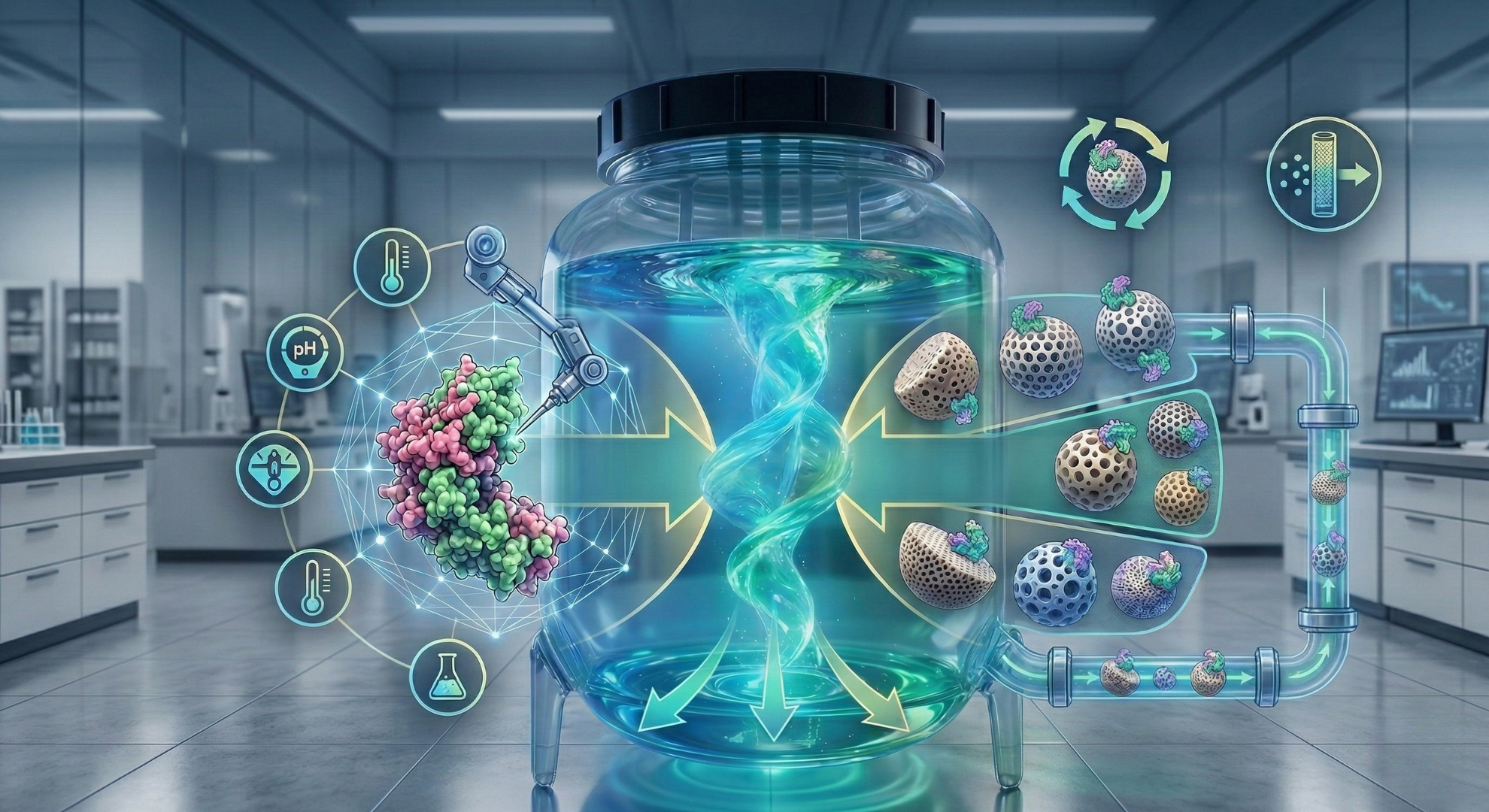
For companies scaling a biocatalytic process presents a complex web of financial and technical hurdles. You are constantly balancing the need for higher yields and robust stability against the harsh realities of production costs.
When preparing for large-scale enzyme applications, two powerful optimization levers exist: Enzyme Engineering and Enzyme Immobilization. Both levers work well to reduce production costs. But a common dilemma arises – which approach should you prioritize, and how do you balance their distinct cost structures?
At Solidzymes, we help you eliminate the guesswork.
Need Help Scaling Your Process?
1. Understanding the Trade-Offs: Engineering vs. Immobilization
To build a truly scalable pipeline, we must first look at how these two distinct approaches fundamentally alter your enzyme and your budget.
Enzyme Engineering Enzyme engineering involves changing the sequence of an enzyme to fundamentally improve its core properties. This approach is incredibly valuable for:
- Decreasing the sensitivity of the enzyme to heat.
- Changing the optimal pH range where an enzyme is most active.
- Changing the solubility or the solvent tolerance of the enzyme.
The Science Behind It: Modifying an enzyme requires extreme precision. One of the core principles of enzymology is that the amino acids involved in an enzyme’s catalytic mechanism must remain in precise geometric alignment. Activity could be abolished if they deviate from their positions by even a few Angstroms. Successful enzyme engineers maintain the catalytic site while changing and optimizing the remainder of the enzyme.
The Cost Paradigm: Enzyme engineering requires a significant upfront financial investment, but once the sequence is optimized, the ongoing application of that engineered trait is essentially free.
Enzyme Immobilization
Conversely, enzyme immobilization relies on holding an enzyme on a solid support in order to carefully control its physical location. This is valuable for:
- Re-using enzymes in continuous flow applications.
- Decreasing the cost of downstream product purification.
- Increasing the overall stability of enzymes.
- Increasing solvent tolerance during the reaction.
The Science Behind It: Extensive research highlights that proper immobilization preserves enzyme activity and selectivity. To accomplish this care must be taken to ensure the attachment method does not occlude the active site or distort the binding pocket.
The Cost Paradigm: Compared to enzyme engineering, enzyme immobilization requires only a small upfront cost to develop. However, it introduces an ongoing operational expense due to the continuous purchasing of the immobilization supports. Therefore, cost of materials should be a major driver during enzyme support selection and development.
| Feature | Enzyme Engineering | Enzyme Immobilization |
| Mechanism | Involves changing the sequence of an enzyme to fundamentally improve its core properties. | Controls the physical location of an enzyme by holding it on a solid support. |
| Key Benefits | Decreases heat sensitivity, changes optimal pH range, and alters solubility or solvent tolerance. | Allows enzyme re-use in continuous flow, decreases downstream purification costs, increases overall stability, and increases solvent tolerance. |
| Upfront Cost | Requires a significant upfront financial investment. | Requires only a small upfront cost to develop. |
| Ongoing Cost | The ongoing application of the engineered trait is essentially free. | Introduces an ongoing operational expense due to the continuous purchasing of immobilization supports. |
2. The Strategic Recommendation: Simultaneous Synergy
A common delay in process development arises from treating enzyme engineering and immobilization as sequential, isolated steps. We recommend pursuing both approaches simultaneously. Why? Because the structural changes made during enzyme engineering rarely change the decision-making process required during immobilization optimization. You do not need to wait for a final engineered enzyme sequence to begin finding the perfect immobilization chemistry. Instead, developing the enzyme sequence and immobilization method in tandem accelerates your time-to-market while still resulting in a cost efficient biocatalyst.
Struggling to integrate your engineered sequences into a scalable pipeline?
Get A Free Quote For Our Custom Enzyme Immobilization Services

3. The Exceptions: When Order of Operation Matters
While simultaneous development is ideal, there are two specific strategic exceptions where sequential enzyme engineering and immobilization are necessary:
- Engineering for better immobilization: Sometimes enzyme engineering efforts are directed at improved immobilization such as introducing specific metal sites, lysines, or cysteines for added covalent attachment points. In this case, the enzyme sequence needs to be changed and validated before beginning immobilization optimization.
- Immobilization first for solvent tolerance: If solvent tolerance is your primary challenge, we recommend testing the immobilization process first to see if the solvent is still an issue with the immobilized form of your enzyme. You should then continue with the more expensive enzyme engineering only if necessary.
Partner With Solidzymes For Seamless Scale-Up
At Solidzymes, we use a broad immobilization approach that will accommodate your enzymes no matter how you engineer them. We are equipped to quickly produce your engineered sequences and seamlessly add them to the immobilization optimization pipeline.
Are you in the middle of engineering your enzyme? Don’t wait, let Solidzymes turn your enzyme into an immobilized biocatalyst that scales.
Ready to optimize your reaction?
References & Further Reading
- Fersht, A. (2017). Structure and Mechanism in Protein Science: A Guide to Enzyme Catalysis and Protein Folding. World Scientific.
- Klibanov, A. M. (2001). “Improving enzymes by using them in organic solvents.” Nature, 409(6817), 241-246.
- Mateo, C., et al. (2007). “Improvement of enzyme activity, stability and selectivity via immobilization techniques.” Enzyme and Microbial Technology, 40(6), 1451-1463.
- Robescu, M. and Bavaro T. (2025). “A Comprehensive Guide to Enzyme Immobilization: All You Need to Know.” Molecules.