
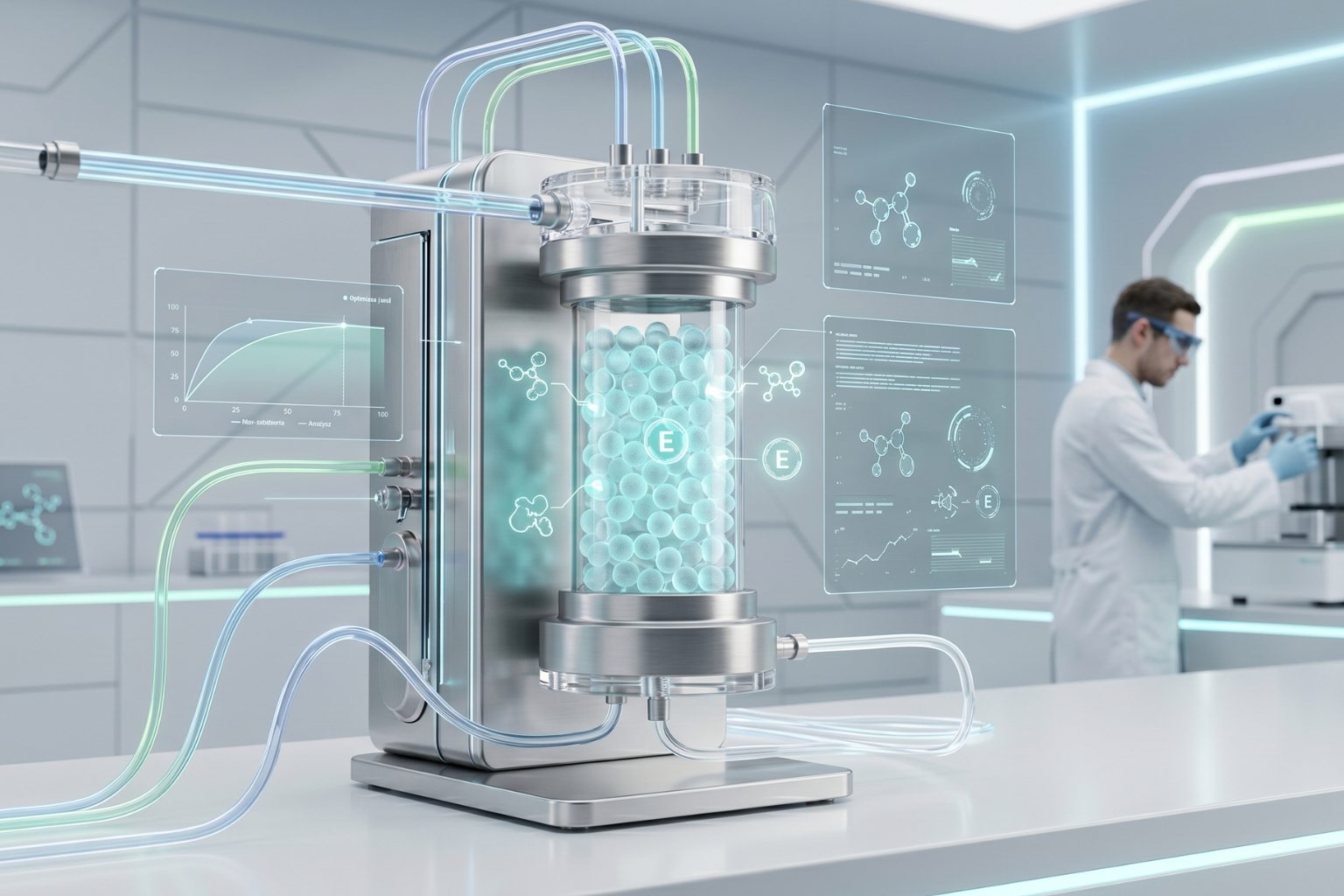
You’ve finally mastered your biocatalytic process in the lab. Moving your enzyme(s) from a successful soluble assay to a scalable manufacturing process is a massive, highly anticipated, milestone for any biotech team. But as you transition to pilot or commercial scale, the realities of biomanufacturing set in. Catalyst costs, downstream processing (DSP) bottlenecks, and regulatory hurdles that were manageable in the lab quickly erode your margins in a large reactor.
Biocatalytic processes become commercially nonviable if expensive, engineered enzymes are lost after a single batch. Those enzymes can rapidly degrade under harsh industrial conditions, or become unwanted contaminates in the final product. If your scale up plans are facing high operational expenditures (OpEx) due to rapid biocatalyst loss or difficult ultrafiltration steps, the most effective solution is often enzyme immobilization.
For innovators, lab directors, and process engineers, there are three primary drivers for enzyme immobilization. Mastering these will protect your process, streamline your purification, and maximize your return on investment.
Wondering if your enzyme is a viable candidate for immobilization? Let Solidzymes evaluate your current benchtop process and project your potential OpEx savings.
Reasons to Immobilize Your Enzyme
1. To Re-use Your Enzymes
By immobilizing your enzyme(s) on a highly engineered, relatively large particle, you transform a single-use consumable into a robust, reusable, processing aid. This dramatically alters the unit economics of your manufacturing process.
- Cost Reduction: Soluble enzymes are washed away after one use. By tethering them to a solid support, you can easily drain the reactor through a standard filter, retain your catalyst, and immediately refill with fresh substrate.
- Enabling Continuous Biomanufacturing: Batch processing often involves costly downtime. Immobilized enzymes allow you to transition to a continuous flow system – such as a packed-bed reactor. Substrate is continuously fed, and product is continuously collected, maximizing facility throughput and equipment utilization.
- Maximizing ROI on Engineered Variants: If you have invested heavily in hyperstable or custom-engineered enzymes, they are designed to run longer under operating conditions. Soluble processes rarely utilize these enzymes to their full potential before they are discarded. Immobilization allows these premium biocatalysts to run continuously to the end of their lifetimes, ensuring you extract every ounce of value from your investment.
2. To Make a Higher Quality, Pure Product
In a soluble reaction, your enzyme remains mixed with your final product. Separating a dissolved protein from your target molecule is notoriously difficult, time-consuming, and expensive. Because immobilized enzymes remain anchored to their solid support and are left behind in the reactor, the product flows out completely free of enzymatic contamination.
- Streamlining Downstream Processing (DSP): Enzyme immobilization effectively eliminates the need for complex downstream purification. By physically retaining the catalyst, you can bypass difficult, high-maintenance, ultrafiltration or expensive chromatography steps, saving significant capital expenditure (CapEx) and processing time.
- Ensuring Strict Regulatory Compliance: Separating enzymes from product is particularly important for decision-makers in the food, beverage, and pharmaceutical industries. Residual enzymes in a final formulation can trigger regulatory red flags, acting as unwanted allergens, or restricted genetically modified ingredients. Immobilization provides peace of mind and simplifies regulatory filings.
- Preventing Undesired Side Reactions: Sometimes multiple reactions can be catalysed simultaneously in an enzyme reactor. By easily removing the product from the catalyst bed at the moment optimal yield is achieved, you gain control over unwanted reactions that lower your overall batch purity.
Need a cleaner product? Let’s design an immobilized enzymatic process to suit your needs.
3. To Increase the Stability and Lifespan of Your Biocatalyst
Industrial reaction conditions are rarely as gentle as conditions enzymes evolved to operate in. Sometimes, coupling disparate enzyme reactions together or achieving optimal substrate solubility requires extreme environments. Immobilizing enzymes on an appropriate surface can make them more resistant to the exacting conditions required for commercial scale-up.
- Fortifying Against Harsh Industrial Conditions: Industrial processes often demand elevated heat, organic solvents, or non-optimal pH levels to dissolve substrates or speed up reaction kinetics. Immobilization protects the structural integrity of the enzyme against these denaturing environments.
- Extending Operational Half-Life: By chemically or physically stabilizing the enzyme molecules through surface interactions with the carrier matrix, the biocatalyst is prevented from unfolding. This allows the enzyme to maintain peak catalytic activity for longer periods under stressful operating conditions.
- Strategic Carrier Customization: True process optimization requires careful selection of the immobilization material (e.g., resins, polymers, silica) and the binding chemistry (e.g., covalent, ionic, adsorption). Testing many enzyme immobilization materials allows selection of the one that actively supports and preserves the enzyme’s activity.

Summary: The Commercial Impact of Immobilization
| Commercial Driver | Primary Impact on Manufacturing | Process Implementation |
| 1. Re-use your enzymes | Lowers OpEx and catalyst cost per kilogram of product | Implement continuous flow systems or simple filter batch reactors |
| 2. Higher quality product | Higher target purity and regulatory compliance | Eliminate costly ultrafiltration and chromatography from DSP |
| 3. Increased stability | Maximizes catalyst lifespan in harsh industrial solvents/temperatures | Carefully select immobilization materials and chemistry |
Let Solidzymes Scale Your Biocatalyst
In summary, the top three commercial reasons to immobilize your enzyme are to reduce catalyst costs through re-use, bypass expensive downstream processing while ensuring a high-quality product, and to fortify the stability of your biocatalyst against harsh industrial conditions. Mastering these challenges through enzyme immobilization can transform a promising benchtop reaction into a truly profitable, scalable, manufacturing process.
You don’t have to tackle the complexities of selecting materials and operating conditions for your process alone. Solidzymes offers specialized immobilized enzyme testing services for innovators interested in improving their biocatalytic efficiency.
Ready to streamline your downstream processing and maximize your commercial yield? Contact Solidzymes today to schedule a discovery call with our technical leadership.
Stop washing your catalyst budget down the drain after a single batch. Partner with Solidzymes to transform your enzyme into a robust, commercial-ready asset tailored specifically to your process.
References
- Nguyen, C. (2025). Enzyme Immobilization: Reimagining Industrial Biocatalysis For A Sustainable Future. Perspective, 14(2). Sustainable Bioprocessing Research Centre, Global BioTech University.
- Maghraby, Y. R., El-Shabasy, R. M., Ibrahim, A. H., & Azzazy, H. M. E.-S. (2023). Enzyme Immobilization Technologies and Industrial Applications. ACS Omega, 8(6).
- Singh, R. K., Tiwari, M. K., Singh, R., & Lee, J.-K. (2013). From Protein Engineering to Immobilization: Promising Strategies for the Upgrade of Industrial Enzymes. International Journal of Molecular Sciences, 14(1), 1232–1277.