
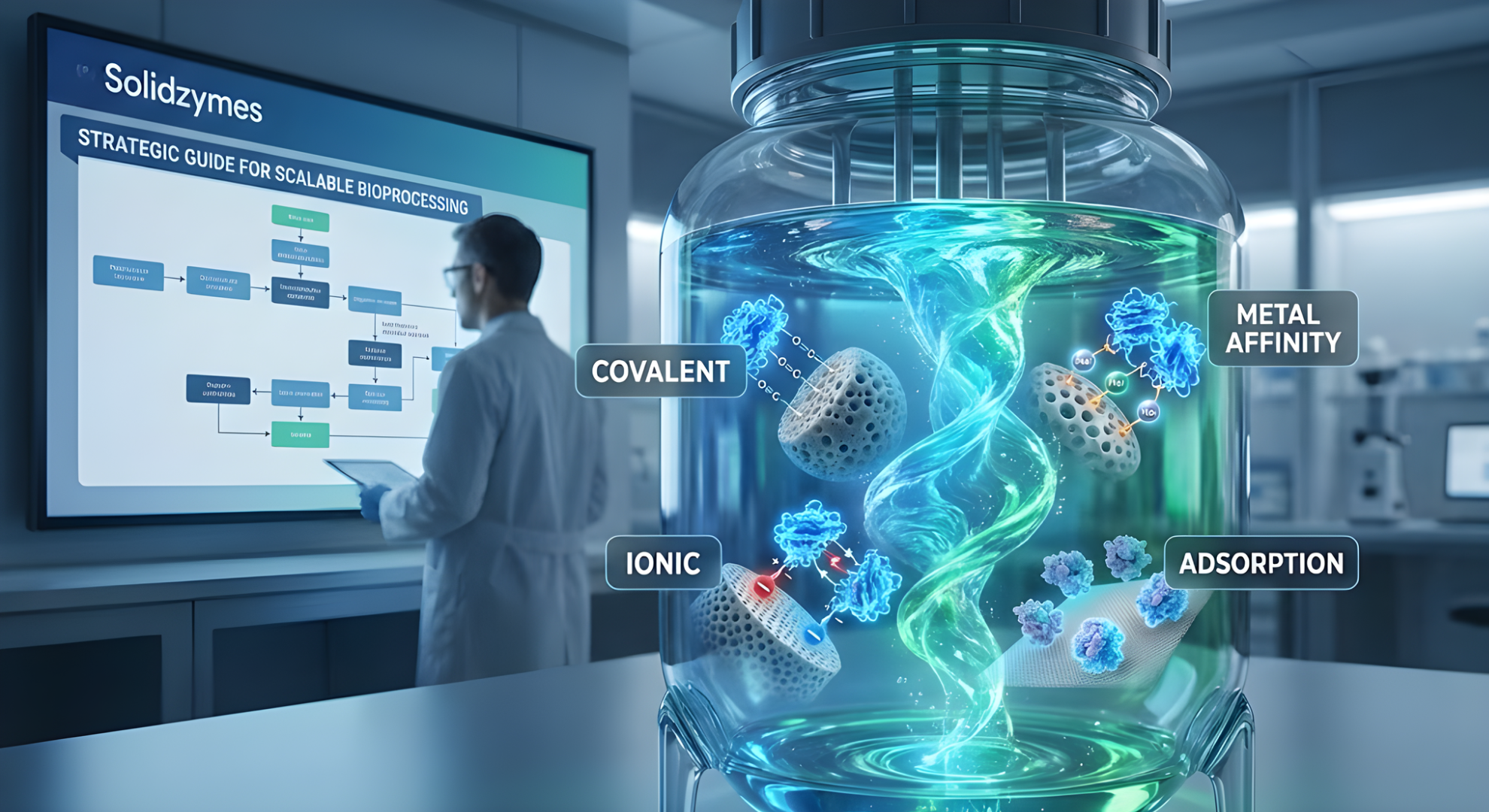
Selecting the correct enzyme immobilization chemistry is critical for process stability and cost. This guide compares covalent, metal affinity, ionic, and adsorption methods to help PIs and Innovators optimize biocatalyst performance for industrial scale-up.
💬 Need help? Talk to a Solidzymes expert today.
Introduction: Why Enzyme Immobilization Chemistry Choice is A Crucial Scale-Up Decision
In the lab, an enzyme’s activity is the priority. At scale, process yield and cost-per-cycle take the lead. Choosing the wrong immobilization chemistry doesn’t just lower yields—it can render an entire bioprocess economically unviable.
For Process Engineers, the challenge is balancing the strength of the enzyme-support bond against the need for material regeneration and cost efficiency.
For many projects, this stabilization step follows successful upstream production; if you are still optimizing your initial yields, see our Guide to E. coli Expression before moving into immobilization.
Below, we break down the four primary chemistries to help you determine the right fit for your specific enzyme molecule.
1. Covalent Binding: The Gold Standard for Permanent Stability
Covalent immobilization involves the formation of a stable chemical bond between the enzyme’s functional groups and the support material.
- The Strength: This is the strongest possible interaction.
- The Advantage: It is ideal for stabilizing the enzyme molecule, preventing leaching even in harsh industrial environments.
- The Trade-off: The interaction is irreversible. Once the enzyme’s activity naturally declines, the support material is difficult to re-use, meaning you must invest in new support for every batch.
- Best For: High-value processes where leaching is a strict “no-go” and enzyme longevity is paramount.
2. Metal Affinity: Precision via Recombinant Engineering
Utilizing metal affinity (including Ni, Fe, or Zn metals), this method mimics the precision of chromatography.
- The Strength: Second only to covalent immobilization, metal affinity uses a recombinant amino acid tag consisting of six or more histidines to create a very strong, specific, interaction between the surface and the N- or C- terminus of the enzyme.
- The Advantage: It simplifies preparation, often allowing for enzyme purification and immobilization in one step. Also, it can be used to orient the enzyme on the surface.
- The Trade-off: It requires a recombinant tag, which can increase the up-front cost of enzyme production.
- Best For: Specialized proteins where purity and specific orientation on the support are critical for activity.
3. Ion Exchange: High Capacity and Cost Efficiency
Ionic immobilization relies on the electrostatic attraction between opposite charges on the enzyme surface and the support.
- The Strength: Despite being non-covalent, it provides a very strong interaction.
- The Advantage: It is excellent for high-capacity immobilization and offers a significant cost advantage because the support material can be stripped of inactive enzymes and regenerated for multiple uses.
- The Trade-off: It can be sensitive to changes in pH or salt concentration in your process buffer.
- Best For: Industrial applications where reducing the cost of support materials is a primary financial driver.
4. Adsorption: The Gentle Approach for Lipases
Physical adsorption is the simplest form of immobilization, involving relatively weak interactions between hydrophobic / aromatic surfaces.
- The Strength: It is a relatively weak interaction compared to the methods above.
- The Advantage: For specific classes of enzymes, such as lipases, hydrophobic adsorption actually promotes an “open” active site conformation, significantly boosting activity.
- The Trade-off: High risk of enzyme leaching if process conditions change.
- Best For: Large-scale lipase applications and processes with very stable environmental conditions.

| Chemistry | Bond Strength | Reversibility | Best Feature |
| Covalent | Extreme | Irreversible | Highest stability |
| Metal Affinity | Very Strong | Reversible | High specificity |
| Ionic | Strong | Reversible | Support regeneration |
| Adsorption | Weak | Reversible | Boosts lipase activity |
Partner with Solidzymes And Develop Your Process with the Right Immobilization chemistry
Choosing a chemistry is only half the battle; the other half is testing it with speed and precision.
At Solidzymes, we offer all of the above immobilization chemistries. Our expertise allows us to match your enzyme to the right chemical approach based on your specific stability and budget requirements.
We utilize purpose-built materials and specialized equipment to quickly test and validate which chemistry will support your enzymatic process appropriately.
Ready to optimize your process? Stop guessing which enzyme immobilization chemistry fits your molecule. Let our experts put them all to the test.
References & Further Reading
- Robescu, M. and Bavaro T. (2025).“A Comprehensive Guide to Enzyme Immobilization: All You Need to Know.” Molecules. (A recent review of immobilization methods).
- Cao, L. (2005). Carrier-bound Immobilized Enzymes: Principles, Application and Design. Wiley-VCH. (Focus on Covalent vs. Adsorption).
- Mohamad, N. R., et al. (2015). “An overview of technologies for immobilization of enzymes and surface analysis techniques for immobilized enzymes.” Biotechnology & Biotechnological Equipment. (Comprehensive review of all 4 types).
- Mateo, C., et al. (2007). “Improvement of enzyme activity, stability and selectivity via immobilization techniques.” Enzyme and Microbial Technology. (Validation of stability claims).